TORONTO - The Canadian housing market appears to be entering a new phase of stability after nearly two years of dramatic price fluctuations, according to comprehensive data released today by the Canadian Real Estate Association (CREA) and corroborated by provincial real estate boards across the country.
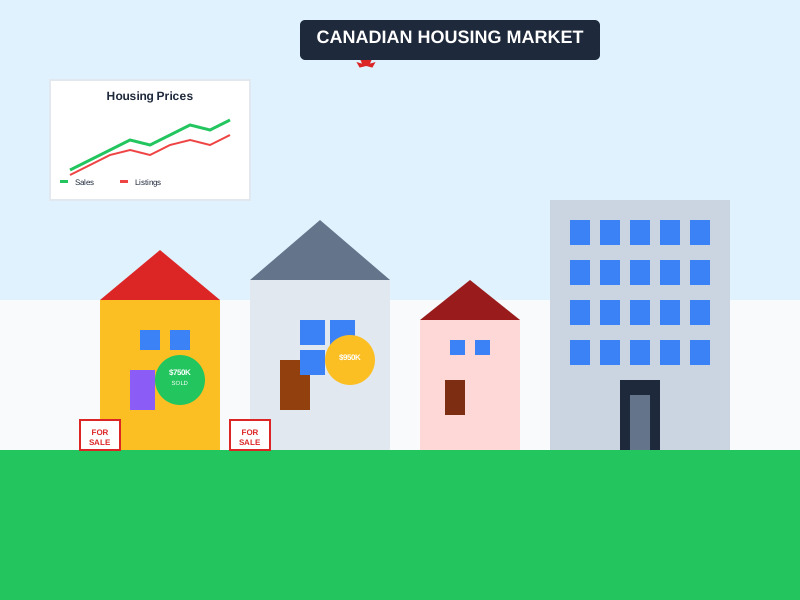
The national average home price held steady at $697,500 in May 2025, representing less than 1% variation from both April and March figures. This marks the first three-month period of price stability since early 2023, when aggressive interest rate hikes by the Bank of Canada began cooling the overheated market.
Market Indicators Point to Balance
CREA Chief Economist Shaun Cathcart described the current market conditions as achieving a "new equilibrium" between supply and demand pressures that have dominated headlines for the past several years.
"We're seeing a market that's found its footing," Cathcart explained during a press conference in Toronto. "Buyers have adjusted to the interest rate environment, sellers have realistic price expectations, and inventory levels are approaching healthy norms."
"We're seeing a market that's found its footing. Buyers have adjusted to the interest rate environment, sellers have realistic price expectations, and inventory levels are approaching healthy norms."
- Shaun Cathcart, CREA Chief Economist
Regional Analysis
The stabilization trend is evident across Canada's major metropolitan areas, though regional variations persist:
Greater Toronto Area (GTA)
The GTA, Canada's largest housing market, saw its average home price settle at $1.12 million in May, down from peaks of $1.35 million in early 2022 but stable for the past quarter. Sales volumes have increased 8% year-over-year, indicating renewed buyer confidence.
Toronto Real Estate Board President Jennifer Pearce noted, "We're seeing first-time buyers re-enter the market in meaningful numbers. The combination of stabilized prices and improved mortgage options is creating opportunities that haven't existed in years."
Greater Vancouver Area
Vancouver's market, traditionally volatile, shows remarkable stability with average prices at $1.18 million. The implementation of provincial speculation taxes and federal foreign buyer measures appears to have achieved policy objectives without creating market disruption.
Montreal
Quebec's largest city continues to offer relative affordability with average prices at $485,000. Montreal has experienced the most consistent growth pattern, with year-over-year increases of just 3.2%, well within historical norms.
Calgary and Edmonton
Alberta's major centers are benefiting from interprovincial migration and renewed energy sector investment. Calgary's average price of $528,000 and Edmonton's $378,000 represent healthy markets with room for growth.
Interest Rate Impact
Bank of Canada Governor Tiff Macklem's decision to hold the overnight rate at 4.75% since March has provided market stability that both buyers and sellers were seeking. Mortgage brokers report that consumers have adapted to the higher rate environment.
"The uncertainty was more damaging than the actual rates," explained Rebecca Martinez, a Toronto-based mortgage broker with 15 years of experience. "Now that rates are stable, people can plan their finances and make informed decisions."
Five-year fixed mortgage rates have settled in the 6.2-6.8% range, with some lenders offering promotional rates below 6% for well-qualified buyers. Variable rates remain less popular, accounting for only 23% of new mortgages compared to over 50% in 2021.
Construction and Supply
Housing construction activity has responded positively to market stabilization. Canada Mortgage and Housing Corporation (CMHC) data shows housing starts increased 12% in the first quarter of 2025 compared to the same period last year.
The federal government's Housing Accelerator Fund has approved 347 projects across 85 municipalities, potentially adding 89,000 new housing units over the next three years. This supply response is crucial for maintaining long-term affordability.
John Peterson, CEO of the Canadian Home Builders' Association, expressed cautious optimism: "Builders are gaining confidence to launch new projects. The combination of stable demand and supportive government policies is creating a better environment for housing development."
Affordability Measures
Despite price stabilization, housing affordability remains a significant concern for many Canadians. The federal government's enhanced First-Time Home Buyer Incentive and provincial programs are showing measurable impact.
Key affordability metrics show improvement:
- The percentage of income required for mortgage payments (debt service ratio) has decreased to 39% from peaks of 45% in 2022
- First-time buyer market share has increased to 31% from lows of 24% in 2023
- Time to save for a down payment has decreased by an average of 8 months in major markets
Market Challenges Remain
While stability is welcomed, several challenges continue to affect market dynamics:
Insurance and Lending Standards
The Office of the Superintendent of Financial Institutions (OSFI) has maintained strict stress testing requirements, limiting access for some borrowers. However, officials indicate no immediate plans for further tightening.
Regional Disparities
Smaller communities and rural areas continue to experience different market conditions. Some regions still face inventory shortages while others deal with oversupply.
Economic Uncertainty
Global economic conditions, including ongoing trade discussions and geopolitical tensions, could impact market sentiment and buyer confidence.
Industry Perspectives
Real estate professionals across the country report improved market conditions and client confidence. Realtor surveys indicate that 67% expect market conditions to remain stable or improve over the next six months, the highest reading since 2021.
Maria Gonzalez, a Vancouver realtor with RE/MAX, shared her observations: "Clients are no longer panicking about missing out or worrying about dramatic price drops. It's become a more rational, sustainable market where people can make thoughtful decisions."
Government Policy Response
Federal Housing Minister Sean Fraser welcomed the market stability while emphasizing continued focus on housing supply. "This stabilization gives us breathing room to implement long-term solutions. Our priority remains increasing housing supply to ensure affordability for all Canadians."
Provincial governments are also adapting policies to the new market reality. Ontario has streamlined development approvals, while British Columbia is expanding its housing supply targets.
Looking Forward
Economists cautiously project continued stability through 2025, assuming no major economic disruptions. The consensus forecast suggests modest price growth of 2-4% annually, in line with historical averages and inflation targets.
CMHC's latest Housing Market Outlook maintains its assessment that most Canadian markets are approaching balanced conditions, a significant improvement from the "highly overvalued" ratings of 2021-2022.
Consumer Advice
Financial advisors recommend that potential buyers take advantage of the stable environment to thoroughly assess their financial readiness. The reduced urgency allows for proper home inspections, neighborhood research, and financial planning.
"This is the first time in years that buyers don't feel pressured to make rushed decisions," noted financial planner David Kim. "It's an opportunity to make informed, sustainable housing choices."
For sellers, the message is equally clear: realistic pricing based on current market conditions yields better results than hoping for a return to pandemic-era price appreciation.
Market Outlook
The Canadian housing market's stabilization represents a return to more sustainable growth patterns after years of exceptional volatility. While challenges remain, particularly around affordability and supply, the current environment provides a foundation for addressing these issues without market disruption.
As summer approaches, traditionally the busiest season for real estate transactions, market participants express cautious optimism that this stability will continue, providing Canadians with housing opportunities that have been scarce in recent years.