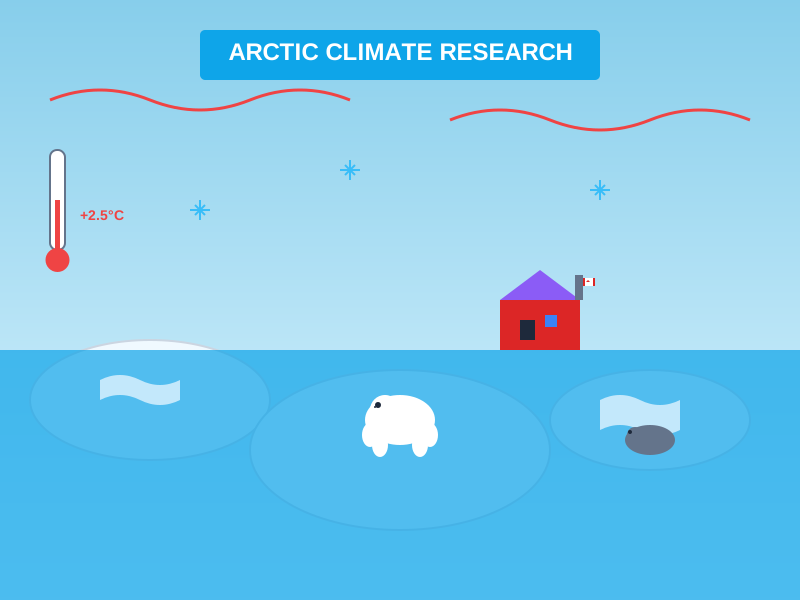
TORONTO - A comprehensive five-year study led by Canadian researchers has revealed that Arctic ice is disappearing at an unprecedented rate, melting 40% faster than previous scientific models predicted and threatening to accelerate global sea level rise beyond current projections.
The groundbreaking research, published today in the journal Nature Climate Change, combines data from satellite imagery, ground-based measurements, and advanced climate modeling to provide the most detailed picture yet of ice loss across the Canadian Arctic Archipelago and Greenland ice sheet.
Unprecedented Data Collection
Dr. Sarah Williamson, lead researcher from the University of Toronto's Department of Physics, explained that the study utilized cutting-edge technology including NASA's ICESat-2 satellite and autonomous underwater vehicles to measure ice thickness changes with unprecedented precision.
"What we're seeing is not just faster melting, but a fundamental change in how Arctic ice responds to warming temperatures," Williamson said. "The traditional feedback loops that once slowed ice loss are breaking down."
"What we're seeing is not just faster melting, but a fundamental change in how Arctic ice responds to warming temperatures. The traditional feedback loops that once slowed ice loss are breaking down."
- Dr. Sarah Williamson, University of Toronto
Key Findings
The research team's analysis reveals several alarming trends:
- Accelerated Surface Melting: Summer ice loss rates have increased by 40% compared to 2010-2015 averages
- Deeper Water Intrusion: Warmer ocean water is penetrating deeper under ice sheets, causing melting from below
- Albedo Effect Breakdown: Reduced ice cover means less sunlight reflection, creating a self-reinforcing warming cycle
- Permafrost Instability: Coastal permafrost is thawing rapidly, contributing additional water to sea level rise
The study focused particularly on the Canadian Arctic Archipelago, where ice volume has decreased by 23% since 2010. This region, containing thousands of islands and extensive ice coverage, plays a crucial role in global climate regulation.
Implications for Sea Level Rise
Dr. François Dubois from McGill University's Department of Earth and Planetary Sciences, who co-authored the study, emphasized the global implications of the findings.
"If current trends continue, we're looking at sea level rise of 15-20 centimeters by 2050, significantly higher than the 8-12 centimeters projected by the IPCC," Dubois explained. "This affects every coastal community worldwide."
The researchers used sophisticated modeling to project impacts on major Canadian cities. Vancouver could see an additional 18 centimeters of sea level rise by 2050, while Halifax faces potential increases of 22 centimeters when accounting for regional ocean dynamics.
Weather Pattern Disruption
Beyond sea level concerns, the study highlights how Arctic ice loss is disrupting weather patterns across North America. The research documents changes in the polar vortex, jet stream behavior, and Arctic oscillation patterns.
"We're already seeing more extreme weather events - the winter storms that hit Ontario and Quebec last February, the unprecedented heat dome over British Columbia - these are linked to Arctic changes," said Dr. Williamson.
The study correlates Arctic ice loss with:
- Increased frequency of atmospheric river events on the West Coast
- More volatile winter weather in Central and Eastern Canada
- Extended drought periods in the Prairie provinces
- Earlier spring melts affecting hydroelectric generation
Indigenous Knowledge Integration
A unique aspect of the research involved collaboration with Inuit communities across Nunavut and the Northwest Territories. Traditional knowledge holders provided historical context and ground-truth observations that enhanced the scientific data.
Elder Mary Kanguq from Igloolik shared observations her community has made over decades: "The ice forms later each year and breaks up earlier. The animals' patterns have changed. The old ways of predicting weather don't work the same way."
This integration of Indigenous knowledge with scientific methodology provides a more complete understanding of environmental changes occurring across the Arctic.
Government Response
Environment and Climate Change Canada has already begun incorporating the study's findings into updated climate projections. Minister Steven Guilbeault announced increased funding for Arctic monitoring stations and enhanced collaboration with territorial governments.
"This research underscores the urgency of our climate action plan," Guilbeault stated. "We're accelerating investments in renewable energy and climate adaptation measures based on these scientific insights."
The federal government is also expanding the Canadian Ice Service's monitoring capabilities and increasing support for Indigenous-led environmental stewardship programs in the Arctic.
International Implications
The study's findings are being closely watched by international climate organizations. Dr. Williamson has been invited to present the research at the upcoming UN Climate Change Conference, where it will inform updated global climate models.
Arctic Council members are using the data to reassess shipping route projections and resource extraction timelines in the region. The Northwest Passage could become regularly navigable by large vessels a decade earlier than previously anticipated.
Future Research Directions
The research team is expanding their monitoring network with additional funding from the Canadian Foundation for Innovation. New projects will focus on:
- Real-time ice thickness monitoring using fiber optic sensors
- Ecosystem impacts on Arctic marine life
- Carbon release from thawing permafrost
- Potential tipping points in ice sheet stability
Dr. Dubois emphasized the importance of continued monitoring: "Understanding these changes in real-time is crucial for both climate science and policy decisions. We need sustained, long-term observation programs to track these rapid changes."
Call for Action
The researchers stress that while the findings are concerning, immediate action can still mitigate the worst impacts. They recommend aggressive greenhouse gas reduction targets and increased investment in climate adaptation infrastructure.
"The Arctic is changing faster than anywhere else on Earth," concluded Dr. Williamson. "But this research also shows us exactly what we need to address. We have the knowledge - now we need the political will to act on it."
The full study, including detailed regional projections and methodology, is available open-access through Nature Climate Change. The research team plans quarterly updates as new data becomes available from their expanded monitoring network.